
Video Coming Soon
Planned: an instructional video to accompany the Learning Center lesson on instruments.
Introduction to Cockpit Instruments
The six primary flight instruments explained one at a time, with a look at how they appear on both analog and glass panels.
The standard “six pack”
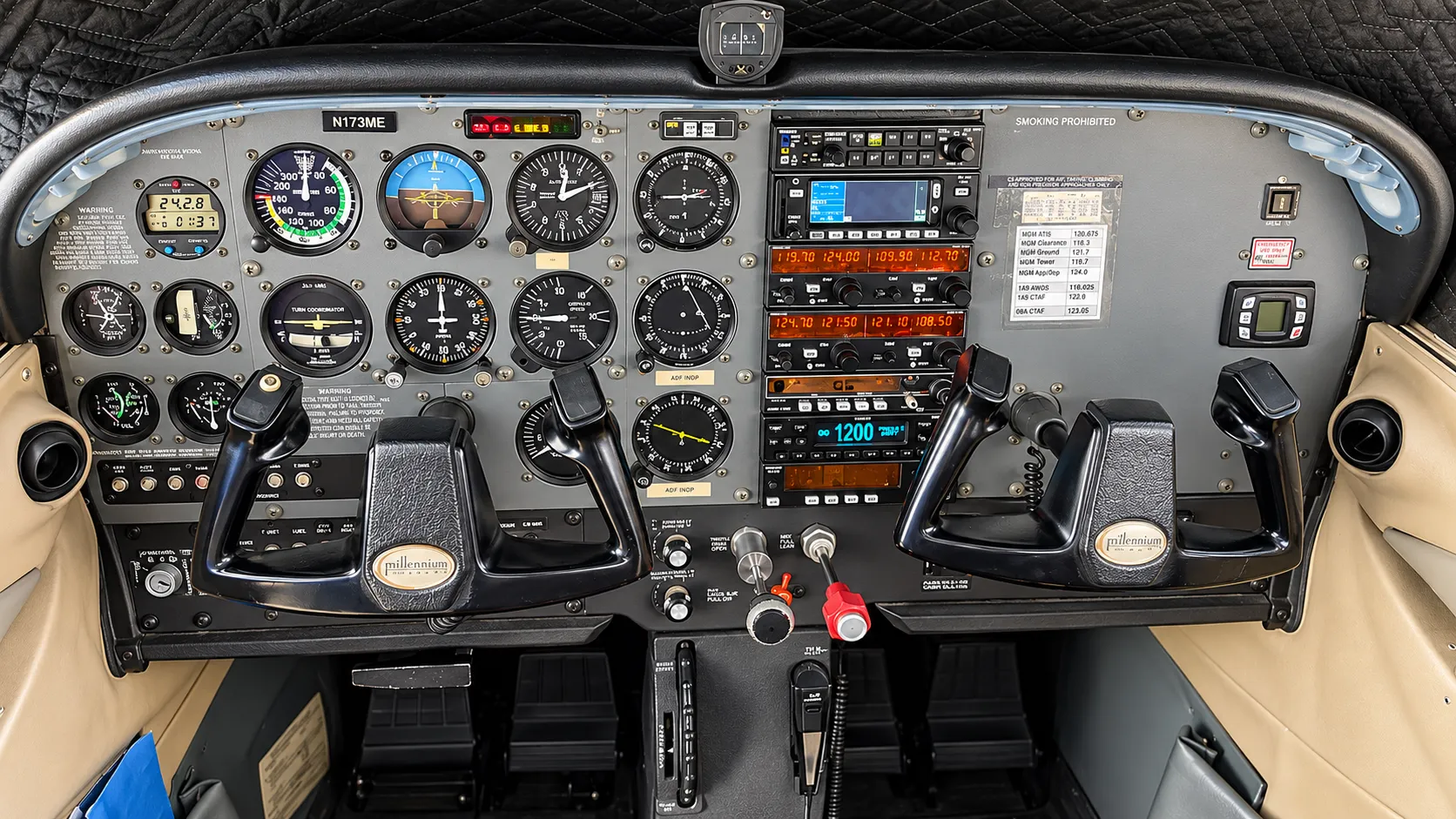
In most light aircraft the six primary instruments are arranged in two rows of three, directly in front of the pilot:
| Top row | Bottom row |
|---|---|
| Airspeed indicator | Turn coordinator |
| Attitude indicator | Heading indicator |
| Altimeter | Vertical speed indicator |
Airspeed indicator
Shows how fast the aircraft is moving through the air, usually in knots. Coloured arcs mark the normal operating range, the flap range, and the never-exceed speed.
Attitude indicator
A small aircraft symbol against an artificial horizon. It shows pitch (nose up or down) and bank (wings level or tilted) at a glance, which is why it sits in the middle of the top row.
Altimeter
Shows height above sea level in feet, read from a pressure setting that the pilot adjusts to the local value.
Turn coordinator
Shows the rate at which the aircraft is turning, and whether the turn is coordinated (the small ball tells you if you are slipping or skidding).
Heading indicator
A compass card that shows the direction the nose is pointing. It is steadier than a magnetic compass and is set to match the compass periodically.
Vertical speed indicator
Shows how quickly the aircraft is climbing or descending, in feet per minute.
The same information on a glass cockpit
A primary flight display combines all six into one screen: airspeed on a tape to the left, altitude and vertical speed on tapes to the right, attitude filling the background, and heading along the bottom. If you learn the six pack first, the glass display reads naturally.
A simple scan
Instructors teach a scan that starts at the attitude indicator and radiates out to the others, always returning to the centre. In a simulator you can practise the scan at your own pace and pause whenever you lose track.
Key takeaways
- The top row shows airspeed, attitude, and altitude; the bottom row shows turn, heading, and vertical speed.
- The attitude indicator is the centre of the scan because it shows the aircraft's pitch and bank directly.
- Glass cockpits present the same six values on a single primary flight display.
Educational material on this website is for familiarization and general interest. It does not replace instruction from a certificated flight instructor, and no simulator time described here should be assumed to count toward any pilot certificate or rating unless Signature-Sky Aviation has confirmed that status in writing.